
Every sensing method has artifacts
Radar may respond to small movement, but responders, machinery, rain, unstable debris and cable motion can create signals. Audio systems are affected by site noise and structure-borne vibration. Cameras need access and visibility. Thermal contrast changes with material and time.
The objective is not to find a perfect sensor. It is to understand what can create a false indication and design the search so independent observations can agree. The life-detection systems guide compares methods by material, distance, target condition and team workflow rather than promising universal certainty.
| Evidence source | Useful signal | Common source of ambiguity |
|---|---|---|
| Radar | Small periodic or gross movement | Responders, machinery, rain and unstable material |
| Audio or vibration | Taps, calls and structure-borne movement | Generators, tools, vehicles and cable motion |
| Camera or probe | Direct visual context | Access, dust, darkness and restricted field of view |
| Thermal sensing | Temperature contrast | Material insulation, weather and elapsed time |
Use a disciplined scan sequence
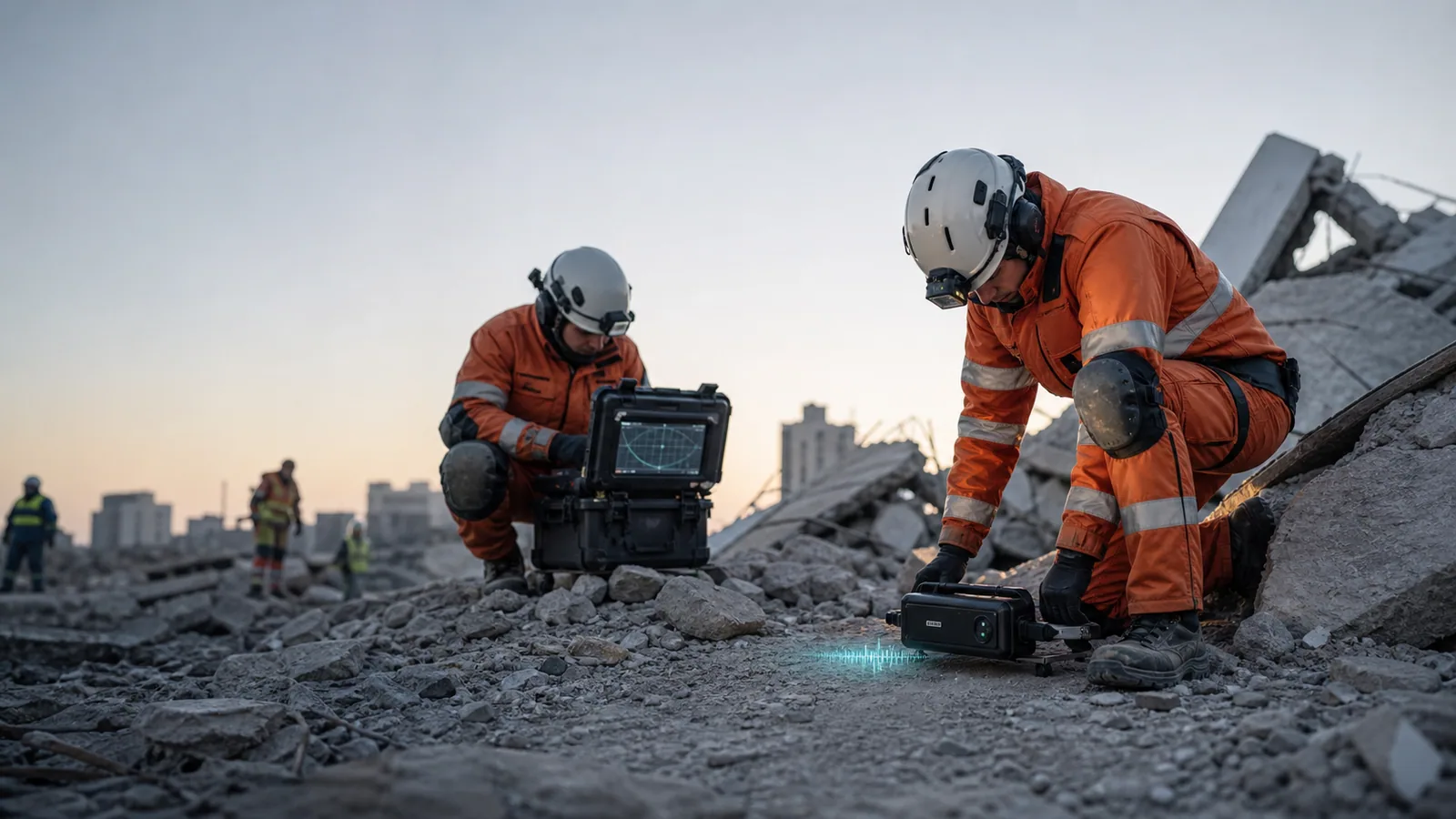
Mark the sensor location and search sector. Control nearby movement where safely possible. Acquire a baseline, scan, pause and repeat after changing one variable at a time. Log settings and environmental activity so another team can understand the result.
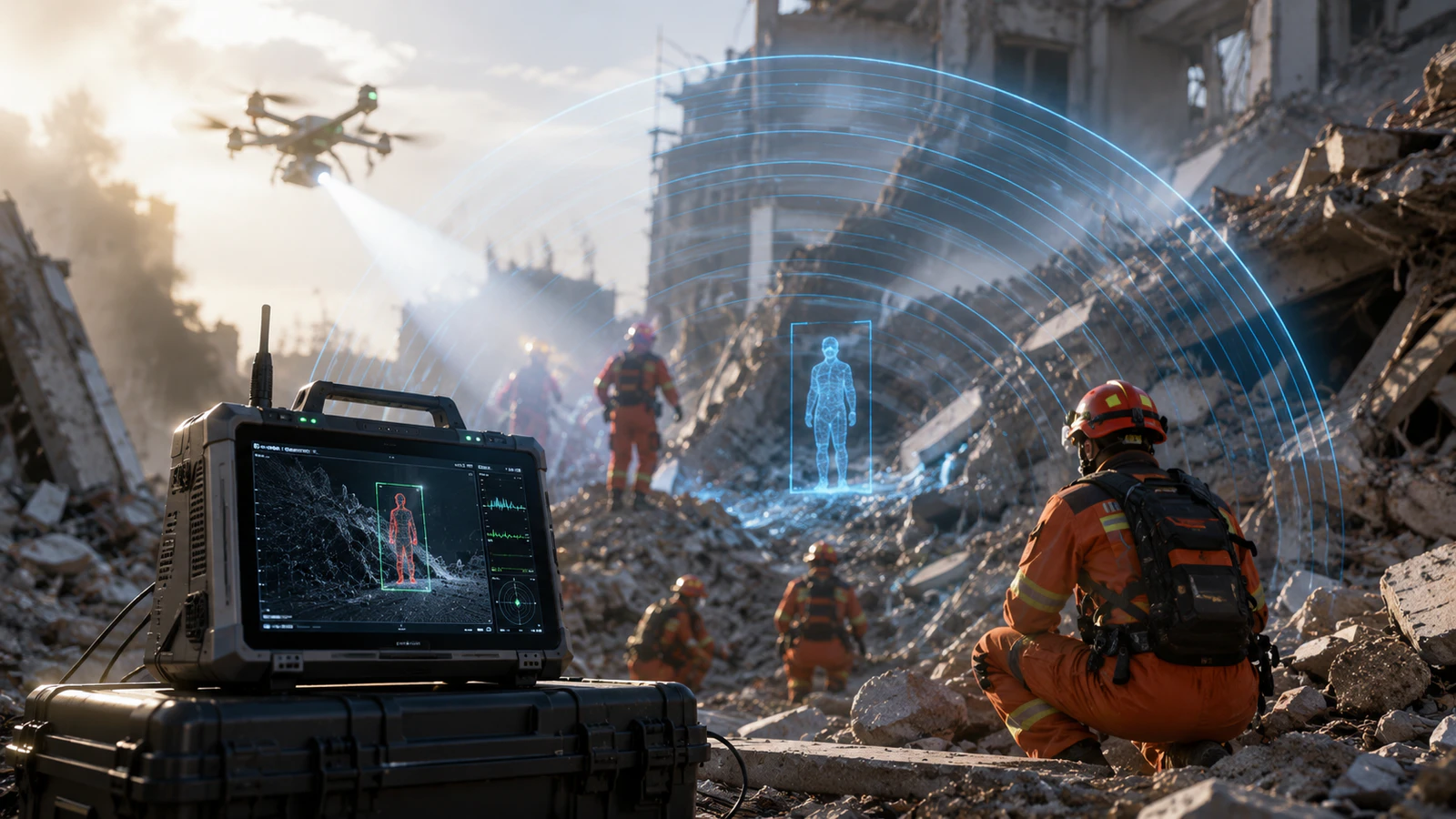
When a possible target appears, repeat from a second position or with another sensor type. The handoff to rescue operations should include confidence, location uncertainty and the evidence behind the judgment.
Technology does not overrule structural safety
A possible detection can change priorities, but it does not make an unstable access route safe. Sensor teams must work within the structural assessment, exclusion zones and command plan.
Training should include no-target exercises and misleading artifacts. Teams learn more from explaining a difficult negative or ambiguous result than from demonstrations designed to produce an easy success. The disaster and emergency response architecture places sensor teams inside that wider command and safety structure.
Procure the training and records with the device
Acceptance should cover setup, baseline control, common artifacts, repeated scanning, battery management, cleaning, storage and result export. The equipment record should identify the delivered sensor, software version and test target.
In mining incidents, the same search discipline must connect to the site’s mining safety and monitoring workflow. The most defensible claim is modest: the instrument provides another source of evidence to a trained search team.
Technical records and related selection material are collected in the OMNI UXV knowledge hub.
Convert the search area into controlled work
Before sensing begins, divide the accessible area into named sectors or cells and define how each will be approached, scanned, repeated and closed. Record sensor position, orientation, stand-off distance, scan duration, settings, environmental interference and the people known to be moving nearby. A positive-looking signal without that context may be difficult to reproduce or hand over.
Use a status model that does not overstate certainty:
| Search status | Meaning | Next action |
|---|---|---|
| Unsearched | No controlled observation has been completed | Plan access and scan sequence |
| Scanned—no relevant indication | No indication under the recorded conditions | Review coverage and move or repeat as required |
| Indication requiring confirmation | A signal differs from the local background | Repeat, relocate or use another method |
| Corroborated area of interest | Independent evidence supports focused search | Escalate to the rescue lead and refine access |
| Closed or handed over | Responsible lead accepts the evidence record | Preserve data and document the decision |
This language keeps the device within its role. It supports prioritization; it does not declare occupancy, identity or survivability.
Control the confirmation process
When an indication appears, repeat the observation without changing several variables at once. First verify that responders, tools, vehicles and loose equipment are stationary or accounted for. Then repeat from the same position, followed by a different angle or distance. Where conditions allow, compare with audio, camera, thermal, canine, visual or structural information.
Mark the area of interest using a coordinate, physical reference and annotated plan. Screenshots alone are not enough if the next team cannot restore the sensor position. The record should distinguish raw observations from operator interpretation and show why the lead chose to continue, change method or close the sector.
Commission readiness, not only sensitivity
Acceptance exercises should include realistic noise, unstable surfaces, low light, protective equipment and time pressure. Test battery changes, accessory setup, file export, clock synchronization, device cleaning and the handoff between operators. Include a no-target scenario and an ambiguous scenario so training does not teach users that every display change is a victim.
Readiness checks should then become routine: inventory, battery state, calibration or self-test, firmware baseline, storage capacity and named trained operators. A device that performs well in a controlled demonstration but arrives with an uncharged battery or an unfamiliar menu does not improve the rescue outcome. The procurement objective is a repeatable evidence contribution within the incident command system.